
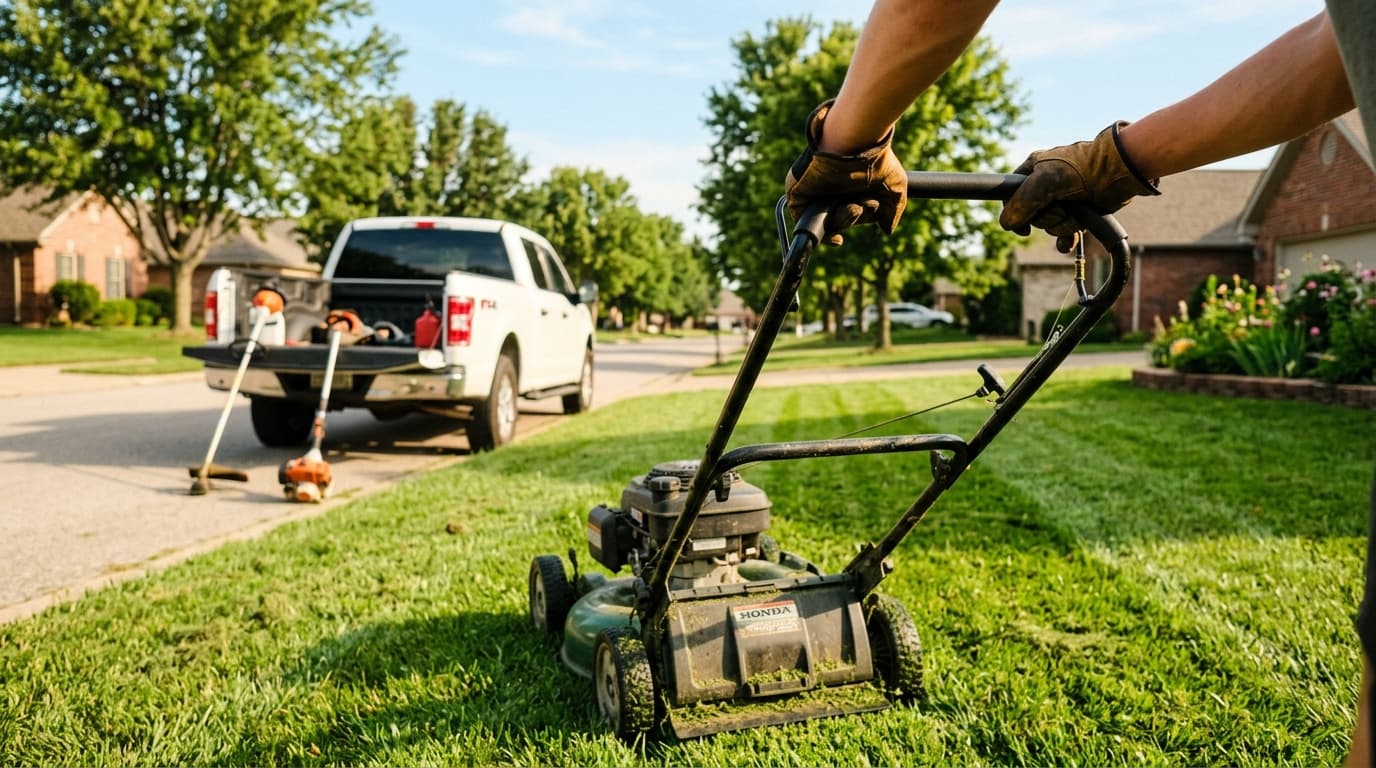

How to Start a Lawn Care Business: The Complete 2026 Roadmap
You don't need a degree, a warehouse, or a pile of cash to start a lawn care business. You need a mower, a plan, and the willingness to knock on doors. That's why lawn care is one of the most common first businesses for young people, and one of the most reliable trades in the country.
The U.S. lawn care market is worth roughly $63 billion in 2026 and growing at nearly 5% per year. The Bureau of Labor Statistics projects 65,200 new landscaping and groundskeeping jobs by 2033. There are over 726,000 landscaping businesses operating in the U.S. right now, and that number keeps climbing. The demand is real. People want their yards to look good, and most of them don't want to do it themselves.
This guide walks you through every step of starting a lawn care business, in the order things should actually happen. Not theory. Not a list of "things to consider." A roadmap, from zero to your first paying clients and beyond.
1. Decide What You're Offering (and What You're Not)
Before you buy a single piece of equipment, get clear on what services you're going to provide. "Lawn care" is broad. Narrow it down.
For most people starting out, the core services are:
- Mowing (your bread and butter)
- Edging along sidewalks, driveways, and flower beds
- String trimming around fences, trees, and obstacles
- Leaf and debris cleanup
That's a solid starting lineup. You can build a full-time income on those four services alone.
What you should NOT offer right away: irrigation work, hardscaping, tree removal, chemical treatments (fertilization, weed control, pest management). Those require specialized equipment, licensing, and insurance coverage you don't need on day one. Add them later once you know the demand in your area.
Pick your customers
Residential is the easiest entry point. Homeowners with quarter-acre to half-acre lots are your ideal first clients. They're predictable, they pay on a regular schedule, and the work is manageable solo. Commercial accounts (office parks, HOAs, apartment complexes) pay more per contract, but they expect professional-grade results, tight schedules, and full insurance documentation. Save those for year two.
Set your pricing
There are two simple models that work when you're starting out:
- Per-visit pricing: Charge a flat rate per mow based on yard size. Most residential lawns run $35 to $60 per visit for a standard mow, edge, and trim. Check what competitors in your area charge and price accordingly.
- Weekly or biweekly agreements: Offer a recurring schedule at a slight discount. This is where the real money is, because predictable recurring revenue lets you plan your week and your income.
Don't overcomplicate your pricing. Pick a number that covers your time and costs, charge it consistently, and adjust as you learn what the market will pay.
2. Make It Legal
You're running a business, not just mowing lawns for pocket money. The legal setup is simpler than you'd think, and it protects you.
Choose your business structure
For most solo lawn care operators, you have two options:
- Sole proprietorship: The simplest. You and the business are legally the same entity. No formation paperwork in most states. The downside: if someone sues your business, your personal assets are on the line.
- LLC (Limited Liability Company): Costs $50 to $500 depending on your state. Creates a legal wall between your business and your personal finances. If a client trips over your equipment and sues, they can go after the business, not your personal bank account.
An LLC is worth the small upfront cost. It's one of the cheapest forms of protection you can buy.
Get your EIN
An Employer Identification Number is free from the IRS. Apply online at irs.gov and you'll have it in minutes. You'll need it to open a business bank account and file taxes.
Register your business name
If you're operating under anything other than your legal name, you'll need to file a DBA (Doing Business As) with your county clerk. This typically costs $10 to $50. Check your county clerk's website for the form and filing process.
3. Get Licensed (It's Simpler Than You Think)
Here's the good news: in most states, basic lawn mowing does not require a special license. You're cutting grass, not wiring a house.
What you will typically need:
- A general business license from your city or county ($50 to $400 per year, depending on location). Check with your city or county clerk's office.
- Sales tax registration if your state taxes lawn care services. Not all do. Check your state's Department of Revenue website.
What does require additional licensing:
- Pesticide and chemical application. If you plan to offer weed control, fertilization, or pest treatment, you'll need a pesticide applicator license. This involves 4 to 8 hours of training and a written exam, administered by your state's Department of Agriculture. Don't skip this. Applying chemicals without the license can result in serious fines.
Licensing requirements vary by state. Texas requires no lawn care license for basic services. Florida is the same for mowing. California requires a contractor's license for landscaping jobs over $500. The safest move: search "[your state] contractor license requirements lawn care" and check your state's licensing board or Secretary of State website directly. Don't rely on secondhand information for legal requirements.
4. Get Insured
Insurance feels like an expense you can skip when you're just starting out. It's not. One broken window, one sprinkler head you didn't see, one slip-and-fall on a client's wet sidewalk, and you're writing a check that could wipe out your first year of profits.
General liability insurance
This is the one you need from day one. It covers property damage and bodily injury claims. For a solo lawn care operator, general liability insurance averages about $550 per year, or roughly $46 per month. That's the cost of one mowing job per month to protect your entire business.
Shop quotes from providers like NEXT Insurance, The Hartford, or Insurance Canopy. Many offer same-day coverage, which means you can be insured before your first job.
Commercial auto insurance
If you're hauling equipment in a truck or trailer, your personal auto policy probably won't cover accidents that happen while you're working. Commercial auto runs $1,200 to $2,400 per year depending on your vehicle and coverage. If you're starting with a personal vehicle and a push mower, you can wait on this one, but add it as soon as you're trailering equipment.
Workers compensation
Not needed until you hire your first employee, but required by law in most states once you do. Budget for it when you're planning to grow.
5. Set Up Your Money
Keep your business money separate from your personal money from day one. This is not optional. It makes taxes far easier, it looks professional, and it protects you if you're ever audited.
Open a business bank account
Walk into any bank or credit union with your EIN, your LLC paperwork (or DBA filing), and your ID. Most business checking accounts are free or low-cost for small businesses. Some good options: Chase, a local credit union, or an online bank like Relay or Mercury.
Decide how you'll get paid
Cash and checks work, but they're slow and hard to track. You want to accept card payments and send professional invoices from the start. This is where having a real operations system matters (more on that in Step 8), but the point is: make it easy for clients to pay you, and you'll get paid faster.
Start tracking your income and expenses immediately
Every dollar in, every dollar out. Gas, equipment, insurance premiums, phone bill (the business portion), marketing costs. You'll need all of this at tax time, and it's ten times harder to reconstruct six months of spending than to track it as you go.
6. Gear Up
You don't need $30,000 worth of commercial equipment to start. You need the essentials, and you need them to be reliable.
The essential three
- Lawn mower ($300 to $800 for a quality push or self-propelled mower). A Honda HRN or Toro Recycler will handle most residential lawns. You don't need a zero-turn on day one. Upgrade when your client list demands it.
- String trimmer ($100 to $300). A gas or battery-powered trimmer for edges, fence lines, and tight spots your mower can't reach.
- Leaf blower ($100 to $400). You need this to clean up clippings from driveways and sidewalks after every job. It's the difference between "some guy mowed my lawn" and "a professional serviced my property."
The rest of the list
- Edger ($100 to $300): Creates clean, sharp lines along sidewalks and driveways. Not strictly necessary on day one if your trimmer can handle edges, but it's a quality upgrade.
- Safety gear ($50 to $100): Eye protection, ear protection, work gloves, steel-toe boots. Non-negotiable.
- Gas cans, oil, spare trimmer line, trash bags ($30 to $50): The consumables you'll burn through weekly.
- A way to haul it all: If you have a truck or SUV, you're set. A small open trailer ($500 to $1,500 used) is the next step once you outgrow your vehicle.
The real startup number
If you already own a mower and a truck, you can start for under $500 in additional gear. If you're buying everything from scratch (but not a vehicle), budget $1,500 to $3,000 for quality equipment that will last. That's one of the lowest startup costs of any trade business.
7. Build Your Brand and Web Presence
You don't need a marketing agency. You need a name, a domain, and a way for people to find you online.
Pick a business name
Keep it simple. Something that says what you do and where you do it. "[City] Lawn Care," "[Your Last Name] Lawn Services," "[Neighborhood] Mowing." Avoid anything clever that doesn't communicate the service. Check that the name isn't already taken in your state (your Secretary of State's website has a business name search).
Register your domain
Buy your domain through a registrar like Namecheap, Google Domains, or GoDaddy. A .com matching your business name is ideal. This costs about $12 per year. Do this early, even if you don't build a full website right away.
Set up a professional email
Use your domain for email (yourname@yourbusiness.com), not a Gmail or Yahoo address. Google Workspace starts at $7 per month. It's a small cost that makes a big difference in how clients perceive you.
Build a simple website
You don't need anything fancy. A one-page site with your services, your service area, your phone number, and a way to request a quote. Bit & Grain includes a business website builder and a client-facing self-booking page that lets potential customers request service directly, so you're not building and maintaining a separate site.
8. Set Up Your Operations System
This is where a lot of new lawn care businesses lose money without realizing it. You're great at mowing, but you're running a business. That means estimating jobs, sending invoices, tracking who owes you money, scheduling your week, and keeping records.
Doing this with a notebook and a text-message thread works for your first three clients. It falls apart at ten.
Bit & Grain is built for exactly this stage: a solo contractor who needs estimating and invoicing, scheduling, job management, and payment collection in one place, without the complexity (or the price tag) of software built for 50-person companies.
Here's what your operations system should handle:
- Estimates: Send a professional estimate before every new job or recurring agreement. The client approves it, you have a clear scope and price in writing. No "I thought it was going to be $40" conversations.
- Invoicing: Send invoices after each visit or on a weekly/monthly billing cycle. Include online payment so clients can pay with a card instead of leaving a check under the doormat.
- Scheduling: Know which clients you're visiting on which days. A visual calendar beats a mental list every time, especially once you're running 15 to 20 yards per week.
- Job tracking: Notes on each property. "Gate code 4421." "Dog in backyard on Tuesdays." "Skip the flower bed on the south side." These details are what separate a professional from a random guy with a mower.
Set this up before you take your first paying client, not after you've already lost track of who owes you what.
9. Get Your First Clients
You have your equipment, your legal structure, your insurance, and your systems. Now you need people to pay you to mow their lawns.
Google Business Profile (free, do this first)
Create a Google Business Profile for your lawn care business. This is how you show up in "lawn care near me" searches on Google Maps. It's free. Add your service area, business hours, services, and photos of your work. This single step will generate leads for years.
Door knocking and flyers
Old school, and it works. Print simple flyers (Canva has free templates) and hit neighborhoods in your target area. Knock on doors where the lawn looks like it needs attention. Introduce yourself, leave a flyer, and move on. Don't be pushy. Be friendly and direct: "I just started a lawn care business in the neighborhood. Here's what I offer. Call me if you ever need help with your yard."
Nextdoor and Facebook groups
Post in your local Nextdoor community and neighborhood Facebook groups. Local service businesses get a ton of work from these platforms. A simple post introducing your business and offering a first-mow discount will get attention.
Ask for reviews early
After your first few jobs, ask every satisfied client to leave a Google review. Five-star reviews on your Google Business Profile will bring in more work than any ad you could run. Bit & Grain has a built-in review request feature that sends your clients a direct link to leave a review after a job, so you don't have to ask in person every time.
Social media
You don't need to be an influencer. Post before-and-after photos of your work on Instagram and Facebook. Tag your location. Use simple hashtags like #LawnCare[YourCity]. Consistency matters more than polish. One post per week showing real work you did is enough to start.
Bit & Grain connects to your social media accounts and lets you schedule posts alongside your regular job workflow, so marketing doesn't become a separate chore you forget about.
10. Run Jobs Like a Pro
Getting clients is one thing. Keeping them is what builds a business. The contractors who last in lawn care are the ones who show up on time, do consistent work, and communicate clearly.
Plan your routes
Don't zigzag across town. Group clients by neighborhood and schedule them on the same day. This saves gas, saves time, and lets you fit more jobs into each day. Bit & Grain's route planning maps your day so you're driving the shortest path between jobs.
Communicate before, during, and after
Let clients know when you're coming. Send a quick message if you need to reschedule due to weather. After the job, send a photo of the finished yard (clients love this, especially if they're at work). Bit & Grain's client portal gives each client a place to see their upcoming schedule, approved estimates, and invoices without calling or texting you.
Handle extras and scope changes
"While you're here, can you also trim the hedges?" That's a change order. Don't do extra work for free. Quote it on the spot, get approval, and add it to the invoice. This is one of the fastest ways new lawn care operators lose money: doing $20 worth of extra work on every visit because they didn't want to have an awkward conversation. Service logs and change orders keep this clean.
Track your time
Know how long each property takes. This is how you figure out if your pricing is right. If a $50 yard takes you 90 minutes including drive time, that's about $33 per hour before expenses. If a $40 yard takes 30 minutes, that's $80 per hour. Time tracking shows you which clients are profitable and which ones are costing you money.
11. Track Your Money and Stay Legal at Tax Time
This is the step most new lawn care operators skip until April, and then they panic. Don't be that person.
Track every expense
Gas, equipment, insurance, phone, marketing, supplies, repairs. Every business expense reduces your taxable income. If you don't track it, you can't deduct it, and you'll pay more in taxes than you need to.
Bit & Grain's expense tracking and receipt scanning lets you snap a photo of a receipt right after you buy trimmer line at Home Depot. It's logged, categorized, and ready for tax time. No shoebox of crumpled receipts in January.
Track your mileage
You drive a lot in lawn care. Every mile between jobs, every trip to the equipment shop, every drive to a client's property is a deductible business mile. The IRS standard mileage rate for 2026 is 70 cents per mile. If you drive 15,000 business miles in a year, that's $10,500 in deductions. Mileage tracking makes this automatic so you're not guessing at year-end.
Pay quarterly estimated taxes
As a self-employed business owner, you don't have an employer withholding taxes from a paycheck. You're responsible for paying estimated taxes quarterly (April, June, September, January). If you skip this and owe more than $1,000 at tax time, the IRS charges penalties. A good rule of thumb: set aside 25 to 30 percent of your profit for taxes.
Use your financial reports
At the end of each month, look at your numbers. How much did you bring in? How much did you spend? What's your actual profit? Bit & Grain's financial reporting gives you that picture without needing an accounting degree. Once you know your real numbers, decisions about pricing, hiring, and growth get a lot easier.
12. Grow
Once you're consistently booked and profitable, it's time to think about scaling.
Lock in recurring revenue
Convert as many clients as possible to weekly or biweekly service agreements. Recurring revenue is what turns a side hustle into a real business. Offer a small discount for clients who commit to a full season. The predictability is worth more than the discount.
Hire your first helper
When you can't physically fit more jobs into your week, it's time to bring on help. Start with a part-time helper who rides with you. Pay them hourly. This lets you take on more clients without buying a second set of equipment immediately. Remember: once you have an employee, you'll need workers compensation insurance and payroll setup.
Add services strategically
Once you've mastered the basics, consider adding:
- Aeration and overseeding (spring and fall, high-margin, low-competition)
- Mulching and bed maintenance
- Seasonal cleanups (spring debris, fall leaves)
- Fertilization and weed control (requires your pesticide applicator license)
Each new service is an upsell opportunity with your existing clients. That's the cheapest way to grow revenue: sell more to people who already trust you.
Raise your prices
After your first year, you'll have experience, reviews, and a track record. You've earned the right to charge more. Raise your prices 5 to 10 percent annually. Clients who value quality won't leave over a few dollars. The ones who do were probably your least profitable accounts anyway.
The Bottom Line
A lawn care business can be up and running for under $3,000. The demand is constant. You can be earning money within weeks.
The difference between a summer side hustle and a real business is how you treat it from day one. Legal structure, insurance, professional systems, clear pricing, and consistent client communication. That's what separates "I mow lawns" from "I run a lawn care company."
Bit & Grain handles the business side so you can focus on the work: estimates, invoices, scheduling, expenses, routes, client communication. Start free today and see how it works.
You already know how to cut grass. Now go build a business around it.