

How to Start an HVAC Business: The Complete 2026 Roadmap
Knowing how to start an HVAC business is a different skill than knowing HVAC. You can be the best tech on the crew, the one who finds the leak nobody else can, and still go broke in year one because you did things in the wrong order. The trade rewards people who are good with their hands. The business rewards people who do the boring setup steps before they take the first call.
The demand is real. The Bureau of Labor Statistics counts about 425,200 heating, air conditioning, and refrigeration jobs as of 2024, with the field projected to grow 8 percent through 2034, much faster than the average job, and roughly 40,100 openings a year (BLS Occupational Outlook Handbook). The U.S. HVAC industry is on track to clear $132 billion in 2026. People will always need to be warm in January and cool in July. That is not the hard part.
The hard part is the order. Get your refrigerant certification before you can legally buy refrigerant. Get licensed before you pull a permit. Get insured before you set foot on a paying job. Below is the roadmap in the order the steps happen, from the day you decide to go out on your own to the day you hire your first tech.
Step 1: Decide what kind of HVAC business you are
Before anything legal or financial, get specific about the work. "HVAC" covers a lot of ground, and the lane you pick changes your license, your tools, your insurance, and your customers.
Pick your answers to these:
- Residential, commercial, or both? Residential is easier to start solo. Commercial pays more per job but needs more capital, bigger crews, and stricter licensing.
- Install, service and repair, or maintenance? New installs are big tickets but lumpy. Service and maintenance are smaller tickets but steady, and they build the recurring revenue that makes a shop worth something.
- What is your service area? A tight radius keeps your drive time down and your reviews local.
Write down a one page plan. Not a 40 page document for a bank. One page: what you do, who you do it for, what you charge, and what it costs you to do it. That last number is the one most new owners skip, and it is the one that decides whether you make money. If you want a deeper read on setting those numbers, we wrote a full breakdown on what to charge for HVAC service calls.
Step 2: Get your experience hours and your EPA 608 certification
This is the step that surprises people coming from other trades. HVAC has a federal certification on top of state licensing, and you cannot skip it.
The EPA Section 608 certification is required by federal law for anyone who maintains, services, repairs, or disposes of equipment that could release refrigerant (EPA Section 608). It comes in four types: Type I for small appliances, Type II for high pressure systems, Type III for low pressure systems, and Universal, which covers all three. Get the Universal. Without a 608 card you legally cannot buy or handle refrigerant, which means you cannot do the job.
You also need hours. Most states want 2 to 5 years of documented experience, often 4,000 to 8,000 hours, working under a licensed contractor before you can sit for your own license exam. If you are reading this and you do not have those hours yet, that is your first move: go work for a good shop, learn the trade and the paperwork, and bank the time.
Step 3: Get your HVAC license (and check your state, because there is no national one)
Here is the thing nobody tells you cleanly: there is no single national HVAC license. There is the federal EPA cert from Step 2, and then a patchwork of state and local rules on top of it.
Most states require a journeyman or contractor license, which usually means passing a trade exam (codes, safety, technical) and a separate business and law exam. License fees commonly run somewhere around $500 to $1,500, though the total cost of testing and prep adds up.
How much this matters depends entirely on where you are. States like California and Florida run rigorous testing and want serious documented experience. Texas issues a state license through its Department of Licensing and Regulation. And roughly 17 states, including places like Ohio, Pennsylvania, Michigan, and New York, do not issue a state level HVAC contractor license at all. That last group is the trap. "No state license" does not mean "no license." It means the authority drops down to the city or county, and you still have to pull permits and often register locally. A tech who hears "my state doesn't license HVAC" and starts working unpermitted is one complaint away from a fine.
The only correct move here is to look up your own state's rules, because they genuinely differ on experience hours, exams, fees, and renewal. Start at your state's contractor licensing board or department of labor, then check the city and county where you will work. If you plan to cross state lines, ask about reciprocity, because some states honor a neighbor's license and many do not. Do not take a blog's word for your state, including this one. Verify it at the source before you bid a job.
Step 4: Form the business and get your EIN
Once you know you can be licensed, set up the legal shell.
Most new HVAC owners form an LLC. It separates your personal assets from the business, so if something goes wrong on a job, your house is not on the line, and it is still simple to run. You can file it yourself through your state's Secretary of State website or pay a service to do it. Then get an Employer Identification Number from the IRS. It is free, it takes a few minutes online at irs.gov, and you need it to open a business bank account, hire, and file taxes.
Register your business name while you are here. Check that it is available in your state and that the matching domain is open before you fall in love with it (more on the domain in Step 8).
Step 5: Get insured and bonded before you touch a paying job
Insurance is not optional, and in most places it is part of getting licensed in the first place.
The coverages an HVAC shop needs:
- General liability. Covers property damage and injuries you cause on a job. It is usually required to hold a license and to win contracts. HVAC installation contractors pay an average of about $75 a month for general liability, though it ranges widely with your size and revenue (Insureon).
- Workers' compensation. Required in most states the moment you have employees. It covers medical bills and lost wages if a tech gets hurt.
- Commercial auto. Your personal policy will not cover a wrecked work van full of tools. This one does.
- A surety bond. Many states and cities require one to license. It is not insurance for you; it protects your customer if you fail to finish the work.
Get quotes before you launch, not after. Insurance can be a real chunk of your startup number, often $3,000 to $8,000 a year all in, and you want it priced into your rates from day one.
Step 6: Set up the money side
Open a business checking account using your EIN. Keep every business dollar out of your personal account. This one habit saves you at tax time and makes you look legitimate to lenders.
Decide how you will get paid before the first invoice goes out. Card payments, ACH, deposits on big installs, and financing options for the customer all matter, because a $9,000 system replacement is a lot to ask someone to write a check for on the spot. The faster and easier you make it to pay you, the faster you get paid.
Set up bookkeeping now, while it is simple, instead of in a panic next April. Even a basic system that tracks what came in and what went out will do at the start, as long as you actually use it.
Step 7: Buy the tools, the equipment, and the van
This is where the real money goes up front. Be honest about the number.
A realistic HVAC startup runs roughly $20,000 to $80,000, depending on whether you go lean or fully equipped. The big buckets:
- The van. A work van runs $20,000 to $40,000 new, and you can find a solid used one for $15,000 to $20,000. Start used if cash is tight.
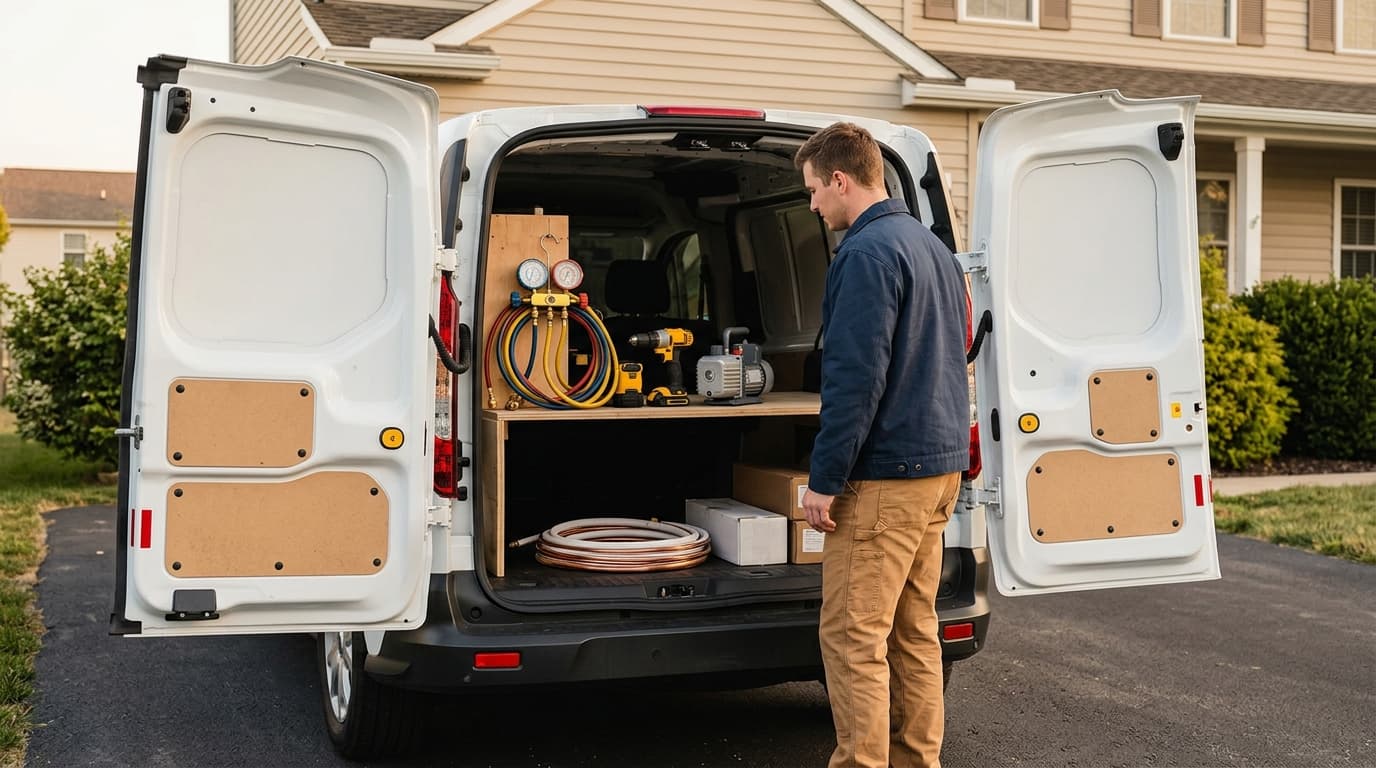
- Tools and equipment. Gauges, a recovery machine, a vacuum pump, meters, a torch kit, ladders, and the rest land somewhere between $15,000 and $30,000 for a full setup, though you can start minimal for $4,000 to $10,000 and add as jobs pay for it.
- Working capital. Keep $5,000 to $10,000 in reserve so you can buy parts for a job before the customer pays you.
Two honest versions of that budget:
| Line item | Lean start | Full setup |
|---|---|---|
| Van | $15,000 used | $40,000 new |
| Tools and equipment | $5,000 minimal | $25,000 |
| Licensing, insurance, formation | $4,000 | $9,000 |
| Working capital | $5,000 | $10,000 |
| Rough total | about $29,000 | about $84,000 |
Neither column is wrong. The lean version is a tech with a used van doing residential service calls. The full version is someone gearing up for installs and a second truck inside the year. Pick the one that matches the work you actually booked, not the one that matches the truck you want.
You do not need everything on day one. You need enough to do the work you booked. Buy the rest out of revenue, not out of a loan you cannot service yet.
Step 8: Set up your brand and your web presence
Your business needs a name, a way to be found, and a way to look real to a stranger deciding whether to let you into their house.
- Lock the name and the domain. Register your domain through a reputable registrar (Namecheap, Cloudflare, and GoDaddy are common choices) and grab the .com if you can. Match it to your business name.
- Get a professional email at your domain, not a free address. "yourname@yourcompany.com" beats "coolhvacguy99@gmail.com" every time.
- Put up a simple website and a Google Business Profile. The Google Business Profile is the bigger deal early on, because that is where local customers find you and read your reviews. Claim it, fill it out completely, and add photos of real work.
You do not need a fancy site to start. You need to exist online, look trustworthy, and be findable in your town.
Step 9: Build the system that runs the jobs
Here is where most new HVAC businesses quietly fall apart, and it has nothing to do with being good at the trade.
You can be the best tech in the county and still lose money if estimates sit in your truck, invoices go out late, and you forget which customer is owed a callback. The office work is the business. Once you are licensed, insured, and ready to take jobs, you need one place to write estimates, send invoices, schedule the day, track each job, and get paid. That is exactly what we built Bit & Grain to do for shops like yours, so a brand new one person operation looks as organized as a company that has been around for 20 years.
A few pieces that matter from the first job:
- Estimates and invoicing that you can send from the driveway, so the customer gets the number while you are still standing there.
- Scheduling and a calendar that keep your day straight and your customers reminded.
The point is not the software. The point is that you decide how the business runs before the chaos decides for you.
Step 10: Get your first customers
Licenses and tools do not pay you. Customers do. Early on, you are not running a marketing department. You are doing a handful of things consistently.
- Google Business Profile and reviews. After every job, ask for a review while you are still on site and the customer is happy. Reviews are the single biggest lever on whether the next stranger calls you. Bit & Grain can ask for those reviews automatically so you are not chasing them by hand.
- The neighborhood. Yard signs, a wrapped van, and word of mouth still work in this trade. Do great work on one street and the neighbors notice.
- Maintenance agreements. This is the HVAC owner's secret weapon. A maintenance plan turns a one time customer into recurring revenue twice a year, smooths out your slow seasons, and makes your business worth more. We went deep on this in our guide to HVAC maintenance software and recurring revenue.
Pick two or three channels and do them every week. Consistency beats cleverness here.
Step 11: Run the jobsite like a pro
As the calls start coming, the daily grind becomes dispatch, parts, and communication. Drop any of those and you get an angry customer and a thin margin.
Keep your schedule and your jobs in one place so you always know who is where and what is next. Track the parts and materials that go onto each job, because an HVAC job that does not capture its real material cost is a job you are guessing the profit on. And when the scope changes mid job, which it will, document the change order and get the okay before you do the extra work, so you actually get paid for it. Bit & Grain handles job and change order tracking so the field and the office stay on the same page.
Communication is the cheap part that wins repeat business. Tell the customer when you are coming, tell them what you found, and tell them what it costs before you do it. People forgive a lot when they are not left in the dark.
Step 12: Stay legal and sane at tax time
Taxes sink new businesses that ignore them all year. You do not have to be an accountant. You have to keep records as you go.
- Track every expense and every dollar of revenue. The bookkeeping you set up in Step 6 only works if the receipts and income land in it.
- Capture receipts on the spot. A receipt for a $40 part you bought at the supply house is a deduction, but only if you still have it in October. Snap it when you buy it. Bit & Grain lets you scan receipts from your phone so they are filed before you leave the parking lot.
- Track your mileage. You live in that van. Business miles are one of the biggest deductions a service business has, and the IRS wants a real log, not a guess. Automatic mileage tracking turns that into money you keep.
- Pay quarterly estimated taxes. As your own boss, nobody is withholding for you. Set money aside every month so the quarterly bill does not blindside you.
Clean books are not just for the IRS. They are how you find out, honestly, whether you are actually making money.
Step 13: Grow on purpose
Once you are steady, growth is a choice, not an accident.
Lean into maintenance agreements to build the recurring base. Hire your first tech when you are consistently turning away work, not before, and bring them on the books with workers' comp from day one. Lean on subcontractors for overflow before you commit to a full time payroll. And keep watching your numbers, because the difference between a busy HVAC business and a profitable one is knowing your real cost on every job.
Common questions about starting an HVAC business
How much does it cost to start an HVAC business? Plan on roughly $20,000 to $80,000. A lean residential-service start with a used van and minimal tools can come in around $29,000, while a fully equipped shop ready for installs runs north of $80,000. The van and the tools are the biggest line items, with insurance and licensing close behind.
Do I need a license to start an HVAC business? You always need the federal EPA Section 608 certification to handle refrigerant, no exceptions. On top of that, most states require an HVAC contractor or journeyman license, and even the roughly 17 states without a state level license still push permitting and registration down to the city or county. There is no version of this where you skip credentials entirely. Check your state.
How long does it take to start an HVAC business? The paperwork is fast. The qualification is not. The business formation, insurance, and setup can be done in a few weeks, but most states require 2 to 5 years (often 4,000 to 8,000 hours) of experience under a licensed contractor before you can sit for your own license. If you already have the hours and the 608, you can be operating within a month or two.
Can I start an HVAC business with no experience? Not legally as the licensed contractor, in most states. You need the documented hours and the EPA 608 to qualify. The honest path is to go work for a good shop first, bank the experience and the certification, learn how the office side runs, and then go out on your own.
Is an HVAC business profitable? The demand is strong: BLS projects 8 percent job growth through 2034 and the U.S. HVAC industry is set to top $132 billion in 2026. But demand is not the same as profit. The HVAC businesses that make money are the ones that know their true cost on every job, keep clean books, and build recurring maintenance revenue instead of chasing one time calls.
Your HVAC business, in the right order
Starting an HVAC business is not complicated, but it is unforgiving about sequence. Certify, license, form the business, insure it, set up the money and the tools, get findable, build the system that runs the work, win customers, run clean jobs, and keep honest books. Do them in that order and you skip the expensive mistakes that catch most first year owners.
The trade work you already know. The business part is just a system, and a system is something you can set up once and run. When you are ready to put the office side of your HVAC business on rails from the first job, start free with Bit & Grain and see your trade's setup at bitandgrain.app/trades/hvac.